
24 August 2023 · Sharon Winson
Choosing the Right Concrete for a Garage Base
C30 or C40? Fibre or air-entrained? A plain-English guide to picking the right concrete for a garage base.
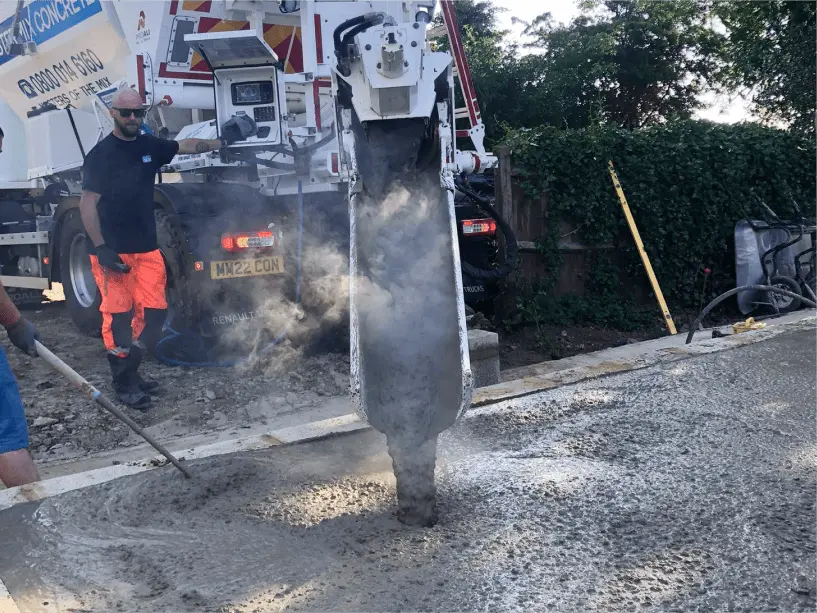
For a standard residential garage base, a C30 ready-mix concrete, rated at 30 Newtons, is the usual choice, ideally with fibre reinforcement added. Heavier-duty bases step up to a C40 mix. The grade and type you choose affects the slab's strength, durability, finish and cost, so it's worth five minutes to get it right.
Why does the type of concrete matter?
Concrete isn't one product. It comes in a range of grades and formulations, and the choice determines how strong the slab is, how long it lasts, how it looks and what it costs. Grades run on a scale from C8 up to C40, with C40 the strongest: the number is the strength in Newtons the concrete is rated to. A garage base carries a building plus, in many cases, a vehicle, so the mix under it is not the place to economise.
What should you consider before choosing?
Load requirements come first. A base for a garage holding a family car has different demands to one supporting heavy machinery or a work vehicle. The heavier the load, the stronger the grade you need.
Environmental conditions matter too. In colder spots, repeated freezing and thawing attacks ordinary concrete over time, and some formulations resist it far better than others.
Finally, think about finish and looks. If the slab will double as a visible floor or apron, decorative options let you colour, stain or texture the surface rather than settling for plain grey.
What are the main types of concrete for a garage base?
Standard ready-mix is the workhorse: Portland cement, sand and gravel (10mm or 20mm), delivered mixed and ready to pour at a consistent quality. For most garage bases, a C30 ready-mix is the standard specification.
High-strength concrete uses a higher cement-to-aggregate ratio to reach C40, a minimum of 40 Newtons. It's the choice where the base will carry serious weight.
Air-entrained concrete has millions of tiny air pockets deliberately introduced into the mix. Those pockets give water somewhere to expand when it freezes, which is what makes this formulation so resistant to freeze-thaw damage in cold climates.
Fibre-reinforced concrete has fibrous material blended through the mix itself, adding tensile strength throughout the slab without the need to place steel.
Decorative or stamped concrete can be coloured, stained or textured. The option to pick when the appearance of the surface matters as much as its strength.
Which concrete should you choose?
Our base teams' rules of thumb, after decades of garage bases:
• Standard residential garage: C30 ready-mix with fibre reinforcement. • Heavy-duty use (heavy vehicles, machinery): C40 with fibre or mesh reinforcement. • Cold, exposed sites: air-entrained concrete for freeze-thaw resistance. • Garage doubling as a workshop or gym: fibre-reinforced mix for the extra resilience. • Appearance a priority: stamped or coloured concrete.
If you're unsure, describe what will sit on the base and how it'll be used. Matching the mix to the job is exactly what a good base layer does for you.
Once you've chosen the mix, the pour is only as good as the frame it goes into. See our guide to setting up shuttering correctly. Or skip the decisions entirely: our own concrete base laying service specifies the right mix for every job as a matter of course. Ask us for a base quote, or browse the full range if you're still choosing the building.
Garage base concrete questions, answered
What grade of concrete is best for a garage base?
C30 (30 Newtons) is the standard for a residential garage base, ideally with fibre reinforcement. Step up to C40 if the base will carry heavy vehicles or machinery.
What does the C number on concrete mean?
It's the strength rating in Newtons. Grades run from C8 to C40: the higher the number, the stronger the concrete, with C40 the strongest on the standard scale.
What is air-entrained concrete for?
Cold climates. Tiny air pockets in the mix give freezing water room to expand, so the slab resists the freeze-thaw cycles that crack ordinary concrete over time.
Is fibre reinforcement worth it for a garage base?
For most residential bases, yes. Fibres blended through the mix add tensile strength across the whole slab without the handling and placement work of steel mesh. It's our recommended specification for a standard garage base.
In short: a standard garage base wants a C30 ready-mix, laid at least 100mm thick and ideally thickened around the perimeter. Step up to C40 where the slab will take real weight, a commercial vehicle, a hoist, heavy plant. Fibre reinforcement blended through the mix is the sensible default for a domestic base, adding tensile strength across the whole slab without the handling of steel mesh, and air-entrained mixes are worth it on exposed sites where freeze-thaw is a risk. Whatever the grade, the slab must be flat, level and square, and cured for at least a week before a building goes on it. Nucrete's own teams lay concrete garage bases across the UK.