
28 August 2026 · Sharon Winson
Does a garden room add value?
A good garden room usually adds value to a UK home, but the build quality and the base decide how much. Here is what actually moves the needle.
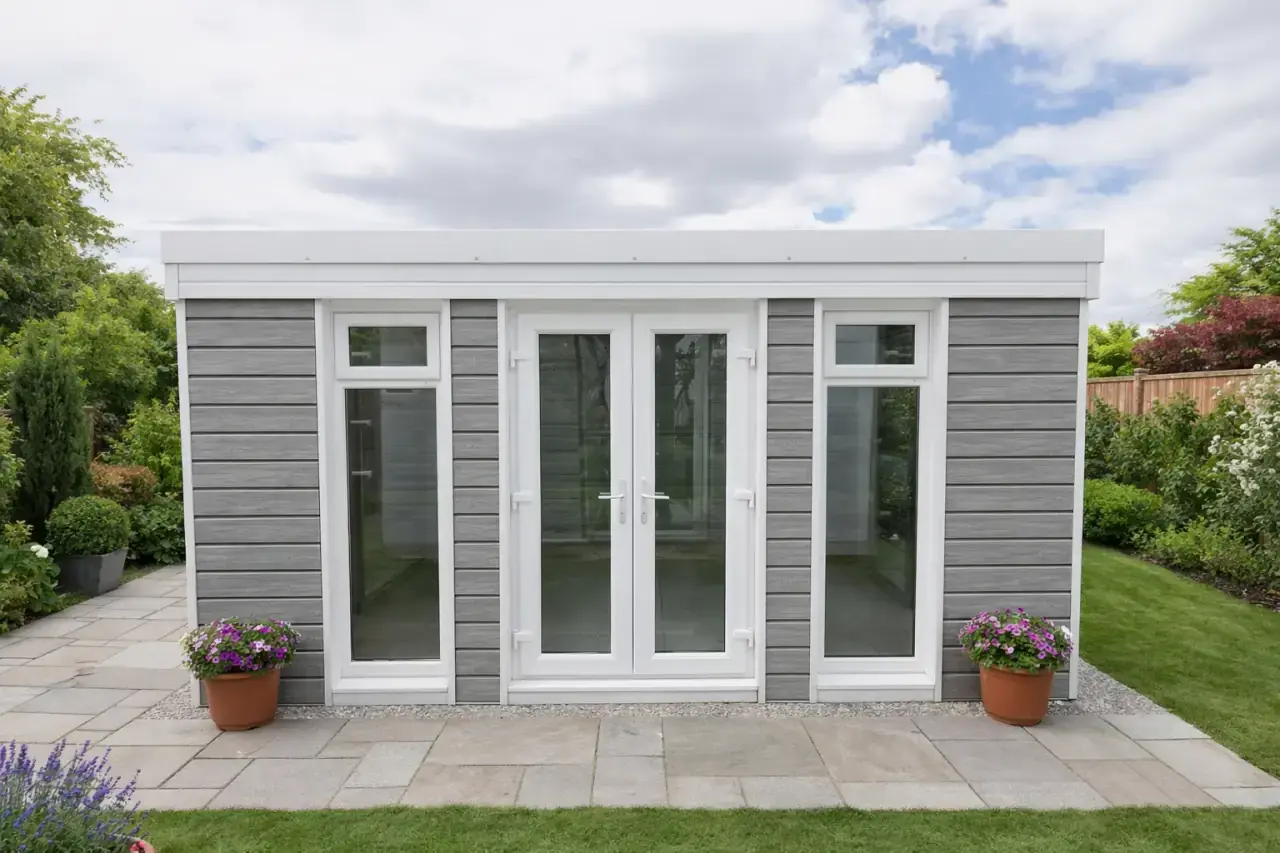
Yes, a garden room usually adds value to a UK home, and it can lift the asking price and the speed of sale. As a rough guide, a well-built, insulated, year-round room can return a meaningful share of its cost when you sell, though the exact figure depends on your area, the quality of the build and whether it sits on a proper base. A flimsy summerhouse on gravel adds far less.
So does a garden room actually add value?
Yes, in most cases it does. Estate agents and valuers treat a genuine, usable garden room as extra living space, and extra usable space is what buyers pay for. The gain shows up in two ways. First, a higher achievable price. Second, a faster sale, because a home with a ready-made office or gym stands out against near-identical houses on the same street.
The honest answer, though, is that not every garden room adds the same value, and some add almost none. A well-insulated room with power, light and a solid floor reads as an extra room. A single-skin timber summerhouse that is freezing by October reads as a shed with windows. Valuers know the difference, and so do buyers walking round on a viewing.
There is no fixed percentage, and anyone quoting a precise national figure is guessing. What is reliable is the direction. Spend sensibly on a room people can use all year, put it on the right foundation, and you should recover a decent part of the outlay while enjoying the space in the meantime. Cut corners and you have spent money the market will not repay.
Our range of Prestige garden rooms is built exactly for that: insulated, low-maintenance and made to last, not a summerhouse dressed up.
How much value does a garden room add?
The value added depends on three things: your local property market, the quality and specification of the room, and how much floor space it gives you. A well-built room in a high-value area, where an extra bedroom or office is at a premium, can return a large share of its cost. In a cheaper area, or with a lower-spec build, the return is smaller.
Think about it in proportion to the house. Adding a smart, insulated room to a family home in a commuter town, where buyers are hunting for home-office space, tends to pay back well. Adding an expensive garden room to a small terrace where it swallows most of the garden can even work against you, because outdoor space matters to buyers too. Balance is the point. The room should feel like a bonus, not a land grab.
Function drives the figure. A room marketed as a home office, gym, hobby studio or teenager's den is easy for a buyer to picture using. That mental picture is what converts into money. A vague, unheated space with no power is harder to sell and adds less. If you want to see how the sums stack up before you commit, our guide on how much a garden room costs sets out the real numbers without the sales gloss.
One more point that people forget. A garden room does not usually add a bedroom to your official room count unless it meets building regulations for habitable use, including insulation, fire and often drainage if there is a toilet. It still adds value as flexible space, but do not assume it counts as a formal extra bedroom on the listing.
If you want to see how the sums stack up before you commit, our guide on how much a garden room costs sets out the real numbers without the sales gloss.
What makes a garden room add value rather than lose it?
The single biggest factor is whether the room is genuinely usable all year. Insulation, a proper roof, real glazing and a source of heat turn a fair-weather hut into a room a buyer will pay for. Without those, you have a shed, and the market prices it as one. This is why our insulated build matters so much: it is the difference between an extra room and an ornament.
Power and light come next. A room with sockets, lighting and a decent broadband reach is instantly a home office. Running an armoured cable out from the house and having it connected by a qualified electrician is not a huge job, but it transforms how the space reads. Buyers want to walk in, plug in a laptop and see themselves working there.
Finish and fit count too. Clean cladding, tidy guttering, level floors and doors that shut properly all signal quality. Cheap materials and a wobbly finish do the opposite. You do not need to gold-plate it, but the room should look like part of the home, not a temporary structure that will be gone in five years.
Finally, keep it looking good over time. Materials that need little upkeep, like composite cladding and steel roof sheets, hold their appearance far better than untreated timber that greys and warps. A room that still looks smart at year eight is worth more than one that looks tired at year three.
We explain the how and why in our piece on the insulated concrete base for a garden room, and it is one of the details a savvy buyer or their surveyor will notice.
Why the base decides whether the value sticks
A garden room only holds its value if it stays sound, and that starts underground. A concrete garden room, and any solid, insulated room worth buying, must sit on a poured concrete base. Paving slabs, gravel, timber bearers and plastic grids are fine under a light timber shed, but they are never an option under a concrete or steel-framed building. Put a proper building on the wrong foundation and it will move, crack and let in damp, and every bit of added value drains away with it.
The base spec is straightforward. It should be 100mm thick, 150mm wider and 150mm longer than the building overall, and left to cure for about a week before anything goes on it. Thickening the outside edge to 150mm is better and worth asking for, but it is optional, and most builders pour a flat 100mm slab unless you request otherwise. Get the base flat, square and level and the building goes up cleanly and stays that way.
For a room you will heat and use daily, an insulated base is a real upgrade. It stops the floor acting as a giant cold plate, cuts running costs and makes the room comfortable in winter. We explain the how and why in our piece on the insulated concrete base for a garden room, and it is one of the details a savvy buyer or their surveyor will notice.
If you are laying the base yourself or hiring a builder, do it properly. Ready-mixed concrete, a hired compactor and a builder's day rate are all normal costs here, and they are money well spent. A rushed, uneven base is the most common reason a good building underperforms.
Our full guide on whether you need planning permission for a garden room walks through the detail.
Do you need planning permission, and does it affect value?
Most garden rooms fall under permitted development, so you often do not need planning permission, but the rules matter and getting them wrong can hurt value at sale time. Permitted development has no floor-area limit, but it does have limits on height, position and how much of the garden you cover, plus tighter rules on conservation areas, listed buildings and land in front of the house. Our full guide on whether you need planning permission for a garden room walks through the detail.
Keep planning permission and building regulations clearly apart, because people mix them up constantly. Planning is about whether you are allowed to put the building there. Building regulations are about how it is built, and the 30m² figure people quote is a building regulations threshold, not a planning one. A garden room used as a simple office or store often sits outside building regulations, but one used for sleeping, or with plumbing, can pull them in.
Why does this matter for value? Because when you sell, a buyer's solicitor may ask for evidence that the building is compliant. If your room needed permission or a regulations sign-off and never got it, that can stall or spook a sale, and you may end up applying retrospectively. A clean paper trail protects the value you have built. If the room clearly sits within permitted development, keep a note of the dimensions and positioning so you can show it.
Which uses add the most value?
A home office is the strongest all-rounder. Working from home is now normal, and a dedicated, quiet, heated space away from the kitchen table is exactly what a lot of buyers want. It photographs well on a listing and it is easy for a viewer to imagine using from day one. That instant usefulness is what turns into money.
A gym is a close second in many markets, especially for busy households that would rather not pay for memberships. A hobby studio, art room or music space appeals to a narrower group but can still clinch a sale with the right buyer. A garden bar or entertaining room is fun to own but adds less reliable value, because it is a lifestyle choice rather than a practical need.
Rooms with plumbing, a shower or a small kitchenette can add the most, because they edge toward genuine annexe or guest accommodation. But they also cost far more, drag in building regulations and sometimes planning conditions, and need proper drainage. The return can be strong, but only if the work is done correctly and signed off. Half-finished plumbing is a liability, not an asset.
Whatever the use, flexibility helps. A room that can obviously switch between office, gym and guest space appeals to the widest pool of buyers. Do not over-specialise the fit-out so heavily that only you would ever want it.
Garden room versus a garage or extension for value
A garden room, a garage conversion and a house extension all add value, but in different ways and at different costs. An extension usually adds the most because it becomes part of the main house footprint, but it is also the most expensive and disruptive, and it eats garden. A garden room is cheaper, quicker and less invasive, and it keeps the house intact while adding flexible space.
A garage is a different proposition again. A good garage adds value through storage and parking, and converting a garage into a room is a well-trodden route, though you can read the trade-offs in our piece on how much value a double garage adds. The key difference is that a garden room is purpose-built as living space, while a converted garage started life as somewhere to park.
For many homeowners, the garden room wins on the balance of cost, speed and disruption. You are not knocking through walls or losing use of the house for weeks. You get a finished, insulated space in a fraction of the time, and if it is built well on a proper base, it competes with far pricier options for the value it returns. Our range of Prestige garden rooms is built exactly for that: insulated, low-maintenance and made to last, not a summerhouse dressed up.
One thing to weigh: an extension is permanent and a garden room is, in principle, removable. Most buyers treat a well-built, connected garden room as a fixture, but the perception of permanence is stronger for brick-clad and steel-framed rooms than for a lightweight timber cabin. Solid construction reassures buyers, and reassured buyers pay more.
How to protect the value once it is built
Keep your paperwork, keep the room maintained, and keep it usable. When you come to sell, being able to hand over the build details, any electrical certificate, and evidence that the room sits within the rules removes the friction that costs you money at the negotiation stage. Buyers pay full price for things they do not have to worry about.
Maintenance is light with the right materials but not zero. Clear the guttering, check the roof fixings, keep the cladding clean and make sure doors and windows still seal. A room that has been looked after shows it, and a tired, leaking one drags the whole garden down in a viewing. This is where low-maintenance composite and steel earn their keep over softwood that needs treating every couple of years.
Finally, do not overbuild for your street. There is a ceiling price for every road, and no garden room lifts a house above what the area supports. Spend in proportion, build it properly, put it on the right base, and the room will do its job: a space you use every day and a genuine asset when you sell.
The short version
A garden room usually adds value to a UK home, both in achievable price and in speed of sale, but the amount depends on your local market, the specification and the foundation. Insulated, powered, year-round rooms read as extra living space and pay back a good share of their cost, while single-skin summerhouses on gravel add little. A concrete or steel-framed room must go on a poured concrete base, 100mm thick and 150mm bigger each way, cured for about a week; slabs and gravel only suit light timber sheds. Keep planning permission and building regulations clearly apart, hold onto your paperwork, and match the build to what buyers in your area actually want. Do that, and the room works twice: useful now, and an asset when you sell.
Common questions
How much value does a garden room add in the UK?
There is no fixed percentage, because it depends on your area, the build quality and the size. A well-insulated, powered room in a market that wants home-office space can return a large share of its cost. A low-spec, unheated cabin adds far less. Build for your actual local market rather than a national average.
Does a garden room count as an extra bedroom?
Not automatically. It only counts as a formal habitable room if it meets building regulations for that use, including insulation, fire safety and drainage where there is a toilet. It still adds value as flexible space and shows well as an office or gym, but do not assume it adds a bedroom to your official room count.
Can I put a garden room on paving slabs or gravel?
Not a concrete or steel-framed one. Solid garden rooms need a poured concrete base, 100mm thick and 150mm wider and longer than the building, cured for about a week. Paving slabs, gravel, timber bearers and plastic grids only suit light timber sheds and are never right under a solid building.
Do I need planning permission for a garden room?
Often not, because most garden rooms fall under permitted development, which has no floor-area limit but does limit height, position and garden coverage. Conservation areas and listed buildings are tighter. Keep this separate from building regulations, where the 30m² figure applies and habitable or plumbed rooms can trigger sign-off.
What adds more value, a garden room or an extension?
An extension usually adds more because it becomes part of the main house, but it costs more, takes longer and is far more disruptive. A garden room is cheaper and quicker, keeps the house intact, and if built well on a proper base it competes strongly for the value it returns.