
Is Your Concrete Base Good Enough for a New Garage?
Four quick checks (flatness, level, size and cracks). Tell you whether your existing base is ready for a new concrete garage. Here's how to run them.
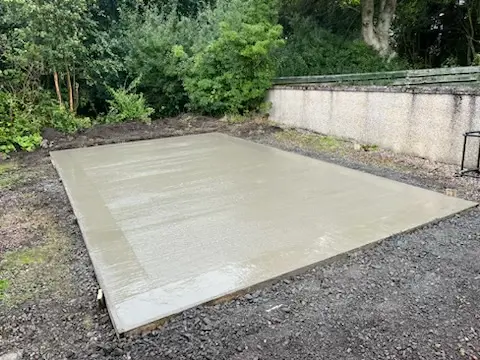
An existing concrete base is usually good enough for a new concrete garage if it passes four checks: it's flat, it's level, it's at least as big as the new building, and it's free of serious cracks or crumbling edges. Most people can run all four checks in ten minutes with a tape measure, a spirit level and a straight piece of timber.
| Check | Tool | Pass looks like |
|---|---|---|
| 1. Flat | Straight timber edge | No daylight under the edge in any direction |
| 2. Level | Spirit level | No fall at all, corner to corner |
| 3. Size | Tape measure | At least as long and wide as the new building |
| 4. Condition | Your eyes | No wide cracks, lifted sections or crumbling edges |
Check 1: is the base flat?
Lay a long straight edge, a straight length of timber works, across the base in several directions and look for daylight underneath. A sectional concrete garage is built from panels bolted together around the edge of the slab, and those panels need even, continuous support. High spots rock the panels; dips leave gaps under them. Either makes the building hard to assemble and puts strain on the joints from day one.
Check 2: is the base level?
Put a spirit level on the straight edge and check from corner to corner. Plenty of older bases were deliberately laid with a fall so rainwater would run off, sensible for washing the car, a problem for a panel building. A base that slopes tips the whole structure: walls lean, the roof line drops, and the door won't run true in its frame. A garage base should have no fall at all.
Check 3: is it big enough for the new building?
Measure the base and compare it with the external size of the garage you're planning. The base must be at least as long and as wide as the building's footprint. A base that's bigger than the building is fine; the garage simply sits on part of it. A base that's even slightly smaller is not, because the panels around the perimeter would have nothing solid to stand on.
Check 4: are there cracks or crumbling edges?
Fine, hairline cracks in the surface are common on older concrete and usually cosmetic. What matters is anything structural: wide cracks, sections that have lifted or dropped against each other, or edges that are breaking up. The edges deserve the closest look, because that's exactly where a concrete garage carries its weight. A crumbling perimeter can't support the panels that sit on it.
What if your base fails a check?
Don't write it off: a failed check rarely means starting from scratch. A base that's sound but uneven can often be skimmed level rather than replaced. One that's cracked, sloping or too small can be broken out and replaced, or a new base laid in a better spot. All of it is work Nucrete does week in, week out, and all our base work carries a 10-year guarantee.
If you're not sure what you're looking at, don't guess: send us a few photos and we'll assess your base free of charge and tell you straight whether it will do.
See what the groundwork involves on our concrete base laying page, or have us check your base from photos with a virtual site survey.
Base assessment questions, answered
Can you check my base from photos?
Yes. That's exactly what our free virtual site survey is for. Send a few phone photos of the base and the access to it, and we'll tell you whether it's good enough for the building you want, usually within a working day.
Can a garage be installed on a slightly sloping base?
It depends how slight. A garage needs a base with no real fall, but a small slope can sometimes be corrected by skimming rather than replacing the slab. Send us photos and measurements and we'll give you an honest answer either way.
Is it cheaper to fix my base or replace it?
Skimming an uneven-but-sound base is usually the cheaper fix; replacement makes sense when the slab is cracked, sloping badly or too small for the new building. Our free quote covers whichever options genuinely fit your base, including telling you it's fine as it is.
Does a new base delay the garage?
Only briefly. Most residential bases are laid in a day, then the concrete needs at least 7 days to cure before the building is installed. We line up the dates so the project runs as one job.
Written and reviewed by the Nucrete team. We assess bases like yours every week before installations, so these are the same four checks our own surveyors run. Unsure on any of them? Send photos and we'll check for free.